
Merrifield City Directory Holdings
Merrifield research starts with the Virginia Room directory inventory at City of Fairfax Regional Library. Its Northern Virginia shelves use nearby city, suburban, county, and telephone headings, so a Merrifield address may appear under Fairfax, Falls Church, Vienna, or a broader suburban title. The list below identifies documented holdings and access routes, not a promise that each volume is on an open shelf. Confirm the call number and availability before visiting.
| Collection | Years | Where Held | Access |
|---|---|---|---|
| Chataigne’s Virginia Gazetteer and Classified Business Directory, Fairfax listings | 1877, 1880, 1884, 1888, 1890, 1897 | Virginia Room | Onsite print; listed call-number examples include VRARE 917.55 Chataig |
| Fairfax County, Virginia Directory | 1906 | Virginia Room | Physical volume, VRARE 917.5529 F 1906, plus a transcribed index link |
| Hill’s Falls Church, Fairfax City, Vienna, and Alexandria suburban directories | 1957-1975, by title | Virginia Room | Onsite city and suburban volumes |
| Fairfax Community Directory | 1980-2005/06 annual ranges | Virginia Room | VREF/VRARE holdings; includes Merrifield |
| Your Community Phone Book and ZipLocal Fairfax Phone Directory | 2006-07 through 2016-17, selected issues | Virginia Room | Onsite telephone and address layer |
| Haines Criss-Cross Northern Virginia | Early 1970s-present | Arlington Center for Local History | Virginia Room directs researchers to Arlington because it does not hold Haines |
The directory inventory also identifies historical telephone books. These are useful dated leads, not a current resident roll. For the local shelf view, use the Virginia Room directories collection before choosing a title or a year.
The directory collection listing shows the kinds of titles and call-number context available for a Merrifield directory search.
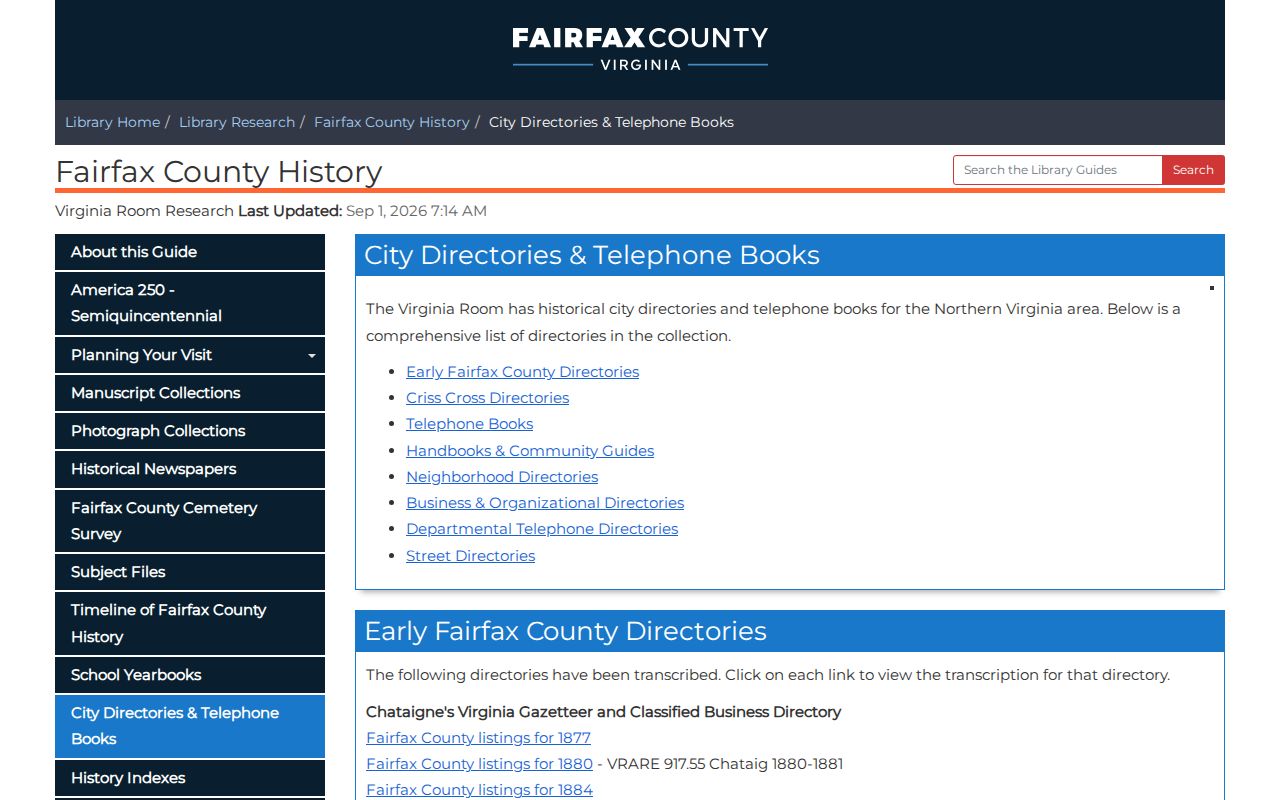
Use its title, edition year, and holding location as the citation for every directory result.
Merrifield Directory Research at Virginia Room
The Virginia Room is on the second floor of City of Fairfax Regional Library at 10360 North Street, Fairfax, Virginia 22030. It offers a microform reader-printer that saves to USB, eight computers, a CPAN station, maps, photographs, manuscripts, local newspapers, rare books, and regional genealogy material. The room can be reached at 703-293-6227 option 6, extension 6, or va_room@fairfaxcounty.gov. Branch hours are generally Monday through Wednesday from 10 to 9 and Thursday through Sunday from 10 to 6, but confirm them before an onsite visit.
Bring the street line, approximate years, former name, and postal-city variants. That narrow request lets staff direct a search to a directory, newspaper index, cemetery inventory, yearbook, map, or manuscript series without treating a membership list as a public roster. The microform reader and onsite collection are the practical fallback when a web index supplies only a title.
Virginia Room access information identifies the local-history setting where the printed and microform runs are consulted.
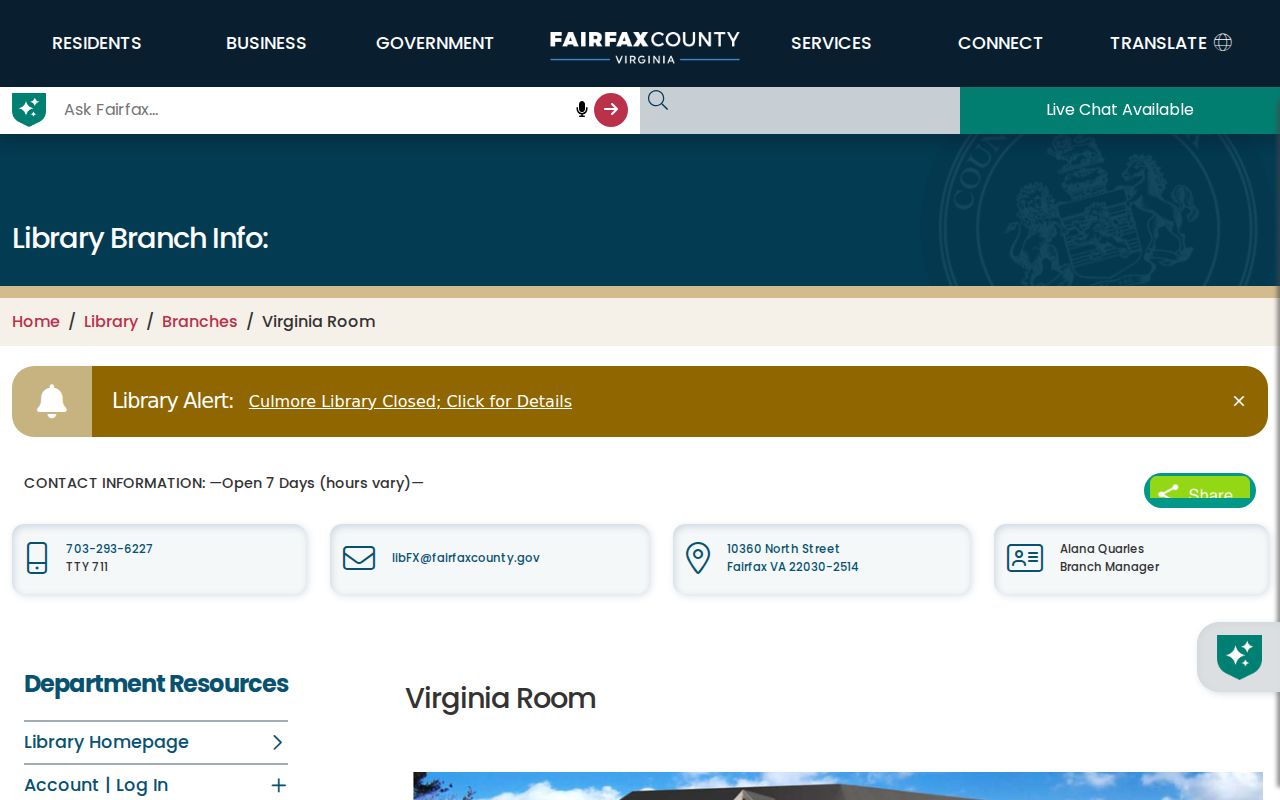
Its equipment and reference collection make the room a useful handoff after an online catalog result.
Note: A listing in a directory records an edition-date contact, not a confirmed owner or present-day occupant.
Early Merrifield City Directory Runs
There is no verified first printed Merrifield-specific directory. The documented historical spine begins with Fairfax listings in Chataigne’s 1877, 1880, 1884, 1888, 1890, and 1897 gazetteers. Hill’s Virginia Gazetteer and Business Directory adds Fairfax listings for 1906 and 1911. P.P. Mast & Co.’s 1878 Names and P.O. Addresses of Farmers in Virginia provides Fairfax listings, while the 1906 Fairfax County, Virginia Directory has both a physical copy and a transcribed index route.
These early sources are especially sensitive to postal-place language. A post-office address or business listing is a historical lead, not a complete household count. Fairfax County formed in 1742, but Civil War losses destroyed original wills, deeds, and loose papers, and the Library of Virginia guide reports that 26 of 56 deed books for 1763-1819 are missing. A gap in an early directory or deed sequence should therefore be recorded as a gap, not turned into a conclusion about a family.
| 1877-1897 | Chataigne’s Fairfax listings provide early people, business, and post-office leads. |
|---|---|
| 1878 | P.P. Mast & Co. offers Fairfax farmer names and post-office addresses. |
| 1906 | Fairfax County, Virginia Directory is held by Virginia Room and has a transcribed-index link. |
| 1911 | Hill’s Virginia Gazetteer adds a later Fairfax listing point. |
Merrifield Directory Community Years
Mid-century research shifts to Hill’s suburban and city titles. The Falls Church run spans 1957, 1959, 1961, 1963, 1965, 1967, 1969, and 1971-1975; the Fairfax City run covers 1963, 1965, 1967, 1969, 1971, 1973, and 1975. Hill’s Vienna volumes, which can be useful on Merrifield’s east and north edge, appear for 1966, 1967, 1970, 1971, 1973, and 1974. Hill’s Alexandria suburban/Fairfax editions are listed for 1966, 1968, 1969, 1971, 1972, and 1973.
The strongest explicit Merrifield collection is the Fairfax Community Directory. Its annual ranges from 1980 through 2005/06 name Merrifield along with nearby communities. Later continuity comes from Your Community Phone Book for 2006-07 through 2009-10 and ZipLocal Fairfax volumes for 2010-11, 2011-12, 2013-14, 2014-15, and 2016-17. Postal labels can change across editions, so search Falls Church, Vienna, Fairfax, Dunn Loring, and suburban headings when the same road is not found under Merrifield.
The Library of Virginia Fairfax County guide is the state archive route for county record groups, microfilm, vital-index material, marriage registers, wills, and court records.
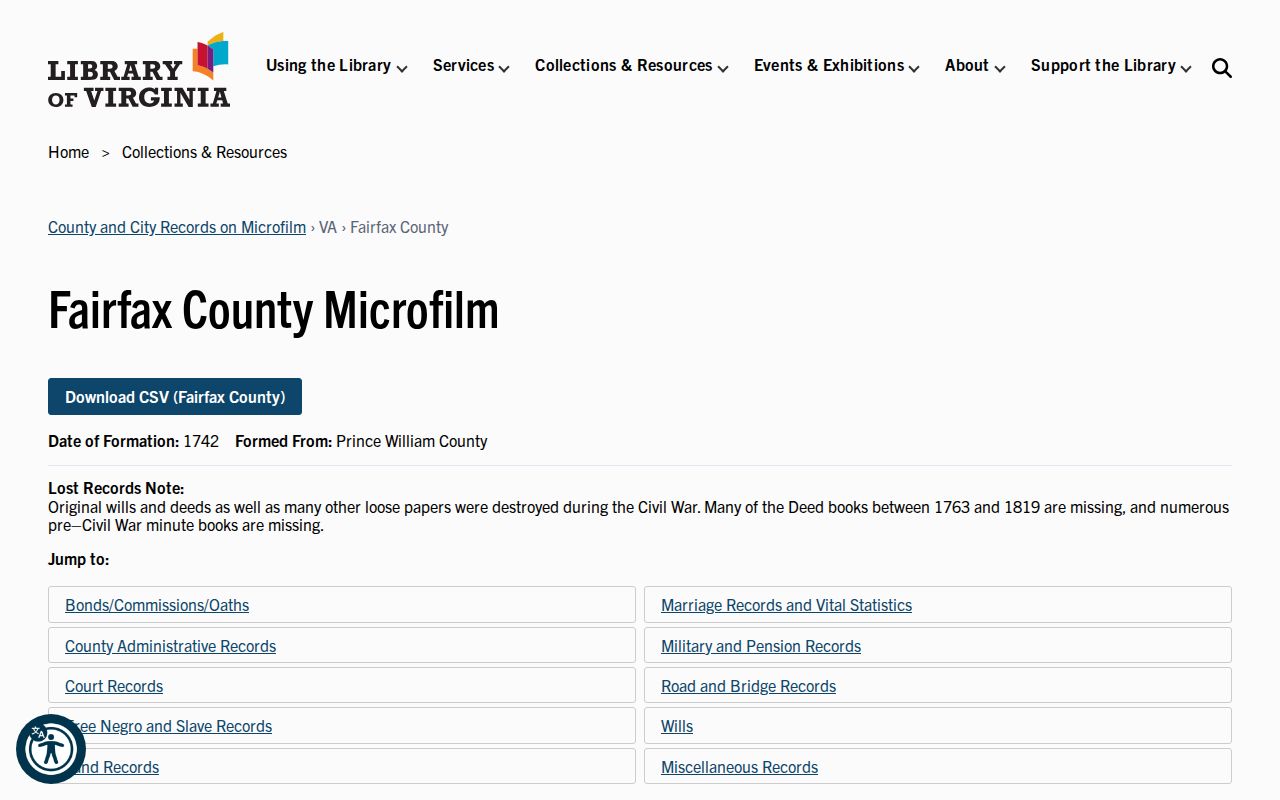
Use the guide to determine whether a related record is a digital index, microfilm, original record, or onsite-only item.
Merrifield Directory Reverse Search
A criss-cross directory is the address-to-name side of a directory. It is valuable when the starting point is a house number and street rather than a person. Virginia Room has several Hill’s suburban sources for that purpose, but it does not hold Haines Criss-Cross Northern Virginia. The Virginia Room directory page directs researchers to Arlington Public Library’s Center for Local History, which holds Haines from the early 1970s to the present and includes Fairfax streets.
That shelf relocation is a useful local research fact. It avoids assuming that an unsuccessful Virginia Room search means the reverse-directory series does not exist. Record the edition, street spelling, city heading, and page, then compare the dated entry with the relevant directory’s alphabetical section and any county property history. A reverse entry is still a historical contact indication, not proof of a full household.
Read a Merrifield City Directory Entry
No line-level image of a local entry was captured in the research. Inspect the actual edition before stating that any field appears for a person. The Virginia Room inspection protocol calls for copying the name exactly and recording the edition, publisher, page, adjacent entries, and whether the volume is alphabetical, classified, reverse, or street-indexed. Where an entry supplies them, preserve an address, spouse notation, occupation or organization, telephone, widow notation, and any ownership or boarding mark.
| Exact name | Copy initials, middle names, hyphens, and spelling as printed. |
|---|---|
| Address and street section | Record the house number, street form, city heading, and page. |
| Relationship or status notation | Capture only notation actually printed, including a spouse or widow reference if present. |
| Occupation or organization | Keep it as a dated identifier, not evidence of a present address. |
| Edition evidence | Save the publisher, year, abbreviation key, and adjacent-entry context. |
- Criss-cross directory
- A directory arranged by street address so an edition can be checked from address to listed contact.
- Householder index
- An alphabetical finding aid that identifies the person or household named by that particular volume.
- Abbreviation key
- The volume’s own explanation of shortened marks and labels. Photograph or transcribe it before interpreting an entry.
Merrifield Directory Companion Sources
When a directory does not settle an identity, Virginia Room collections offer separate checks. The school-yearbook holdings can connect a former classmate to a school year, photograph, activity, or caption. The historical newspaper index can point to a newspaper, date, page, and headline, after which the article is read on microfilm or through an eligible library database route. The cemetery inventory, property-history bibliographies, maps, photographs, and manuscript collections can supply place or family context.
Yearbooks and newspapers should be paired with a census, obituary, directory, or official record rather than used alone. The newspaper index has nonconsecutive coverage, and the exact live field order was not captured. Ask Virginia Room staff which microfilm or database route holds the cited article.
Virginia Room yearbook holdings provide a separate, date-specific check beside directory research.
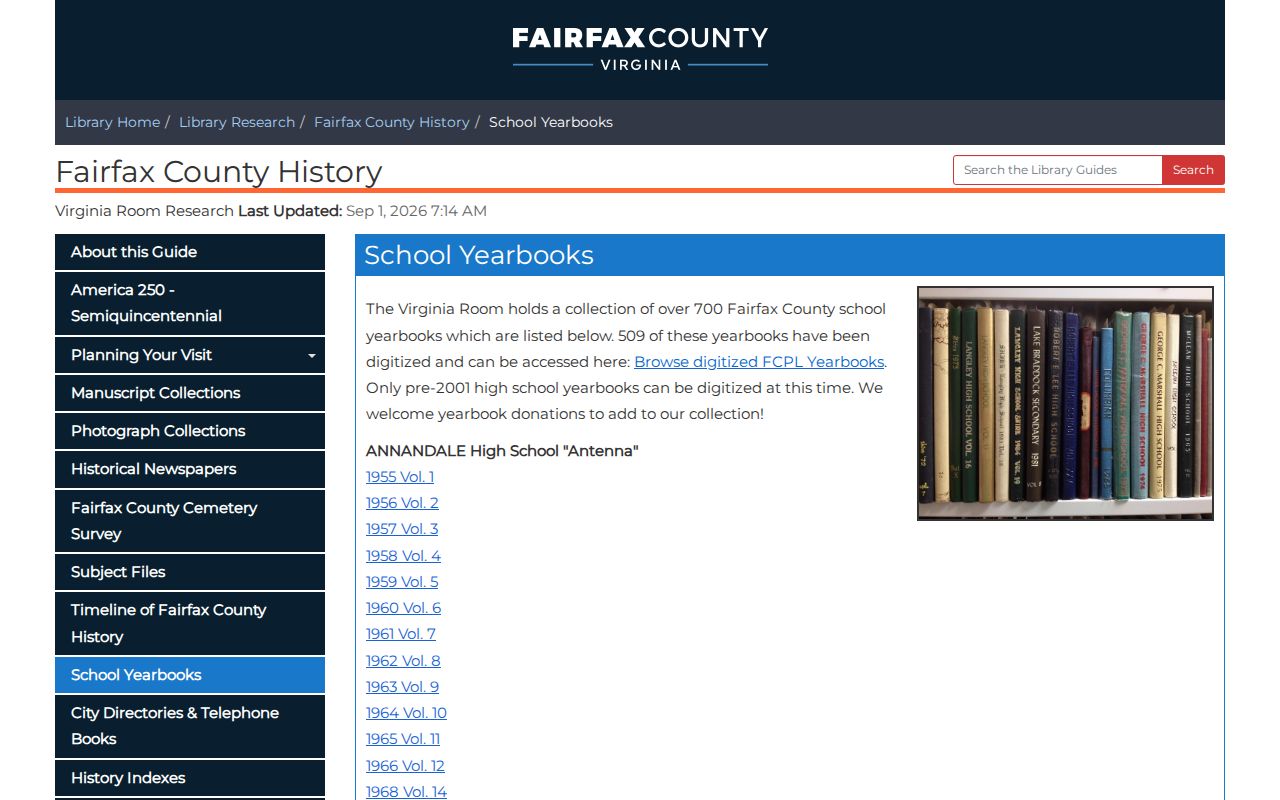
A yearbook can confirm a school-era connection without establishing a current address.
The Virginia Room historical newspaper index is the first step toward a cited newspaper issue and microfilm follow-up.
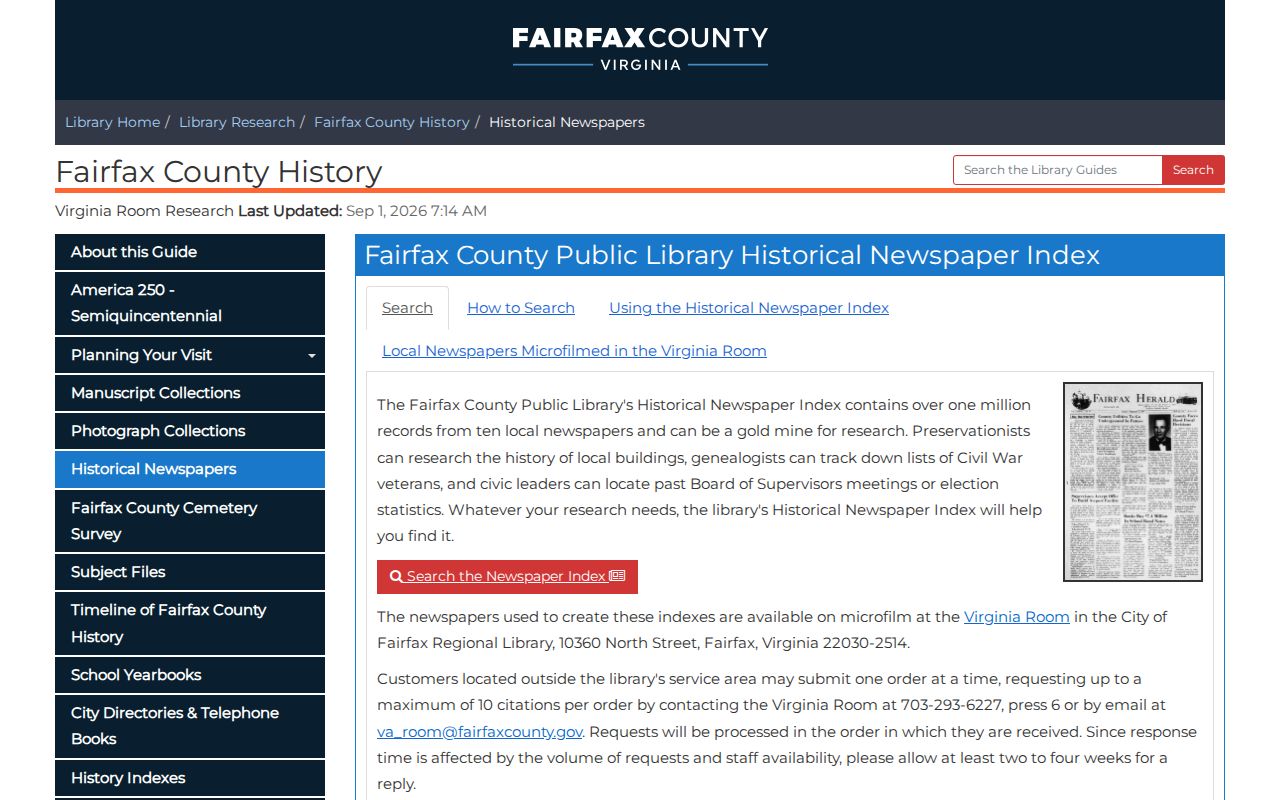
Record the newspaper title, date, page, and headline rather than relying on an index result alone.
Trace Merrifield City Directories by Household
Begin with a known address and a year. Check the street or reverse section for the listed contact, then search that name in the alphabetical section of the same edition. Repeat with one edition before and one edition after. Keep every change in address, spouse notation, occupation, organization, or postal heading as a dated observation. A deed can follow legal ownership, while directories and census schedules supply different evidence about people at an address.
- Write down the address exactly as it appears, including the city or suburban heading and edition year.
- Check the street or criss-cross section, then the alphabetical section, and cite both pages if both exist.
- Compare nearby editions for a move, a name variation, or a changed street heading.
- Pair each interval with the federal census snapshots available from 1790 through 1950 under the 72-year release rule.
- Use the newspaper index, cemetery inventory, probate, or a deed legal description to test an endpoint or address transition.
Federal census schedules are snapshots, while directories can provide annual or near-annual continuity between them. A disappearance can reflect a move, a changed listing practice, death, an unlisted number, or a different postal heading. It needs another source before being read as any one event. For a modern parcel or a street-by-street record chain, use the Merrifield street directory rather than extending a historical listing into the present.
Note: Preserve the source type and date at every step because ownership, directory contact, and census household evidence answer different questions.
Merrifield Directory Archive Handoffs
The ARVAS finding aid describes Historical Society of Fairfax County Records, MSS 05-01, as 1946-2016 material totaling five linear feet and 192 components. It is held with Fairfax County Public Library’s Virginia Room and has no digital objects online. The collection includes membership applications and lists with addresses, correspondence, genealogy requests, event records, historical papers, and yearbooks from 1951-2008. It is an onsite research lead, not a web person search or a roster for republication.
Older county context is split again between the Virginia Room, the Library of Virginia guide, and Fairfax’s Historic Records Center. HRC preserves early books and loose papers and requires an appointment for onsite viewing, while documents and deeds use different public-terminal and CPAN routes. The 2025 Fairfax preservation grant for the 1879 Atlas and land tax books from 1892, 1900, and 1910 may add useful land chronology, but it does not replace a directory citation.
The ARVAS Historical Society finding aid identifies the collection’s dates, extent, components, and repository contact.
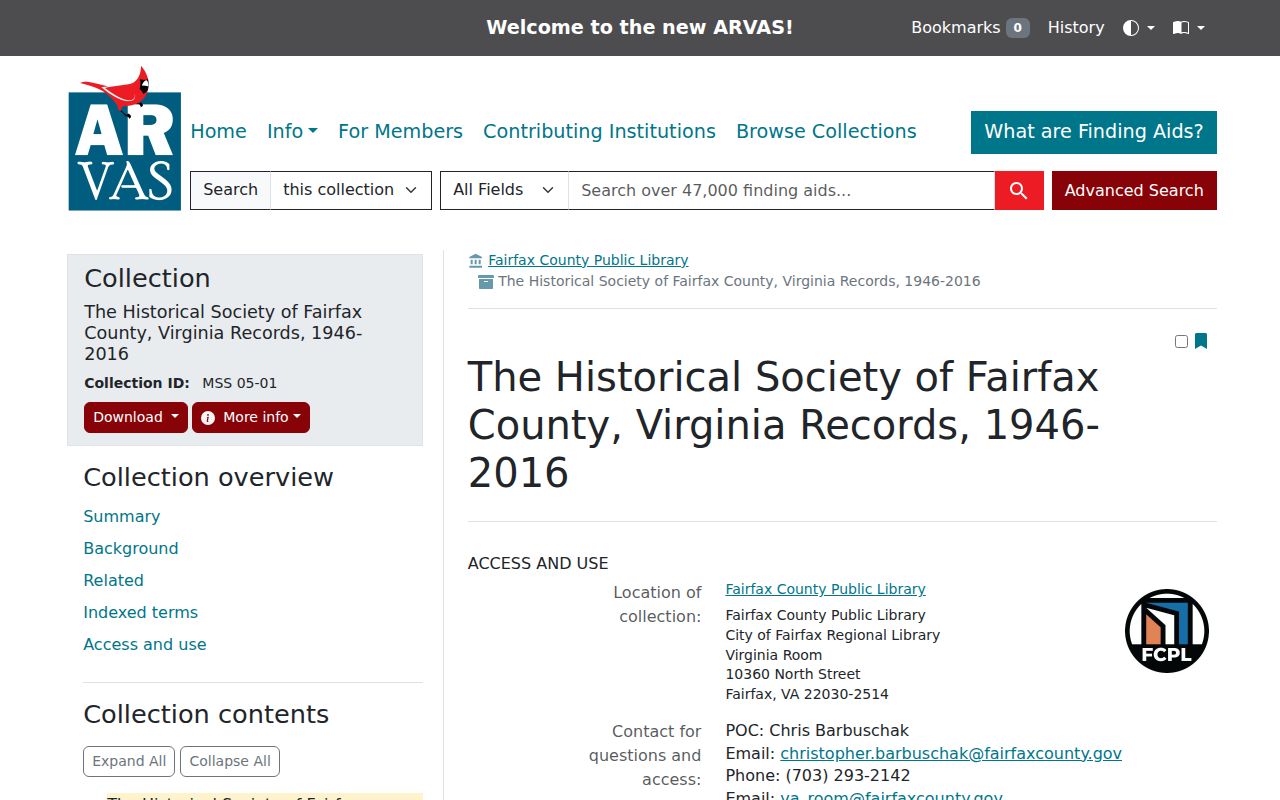
Repository contact and onsite access protect the collection’s context and privacy limits.