
Sources for Past Residents at a Merrifield Address
The best source depends on the era and the question. Fairfax land records document recorded ownership, but they do not make a household list. A reverse directory can tie a name to an address in the year printed. Census schedules show a household snapshot after the address and district have been reconciled. Maps and aerials date land or structures, not people. Keep those roles separate when tracing previous residents of one property.
| Source | Years It Covers | Where Held | What It Shows |
|---|---|---|---|
| Fairfax deed books and index | Documents from 1742 to present; HRC books before 1945 | Circuit Court, CPAN, public terminals, and HRC | Recorded ownership, instruments, and legal descriptions |
| Fairfax map leads | 1760 owner and occupant map; 1860 biography and tax map | Historic Records Center onsite | Names connected with mapped land in a specific year |
| Directories and criss-cross volumes | Early gazetteers from 1877; mid-century reverse volumes; later community and phone books | Virginia Room and Arlington local history | Dated address-to-name and name-to-address leads |
| Federal census schedules | Public decennial schedules through 1950 | National Archives and library genealogy databases | Historical household, age, relationship, and birthplace details |
| Maps, aerials, and newspapers | Aerial imagery from 1937; annual property maps from 1960; newspaper coverage varies | Fairfax GIS and Virginia Room resources | Structure, parcel, address, death, and family-context clues |
Start with the current parcel for a recent question. For an older Merrifield address, start with the legal description and street variants before concluding that a paper directory or deed index has no match.
Freeze the Merrifield Parcel First
Before looking for past residents, capture the current Fairfax property report. The DTA iCare assessment site can return the owner or entity, tax mailing address, situs address, parcel or PIN, sale date and price, physical details, and assessment neighborhood. The site is updated twice weekly. Its current owner field is a useful index into the purchase deed, not a finding that the owner lives at the property.
Write down the current address exactly as displayed, including the postal city and ZIP. Merrifield is an unincorporated community, so a county parcel can use a Falls Church or Vienna postal label. A PIN and legal description are more durable bridges than normalizing an older record to a modern mailing label. Compare the parcel with Jade GIS and Fairfax map resources before taking the ownership trail backward.
Trace Merrifield Previous Residents Through Deeds
Fairfax Circuit Court holds the county’s land records, rather than a separate recorder. The Land Records research route explains the public research paths. A deed index usually needs a grantor or grantee name, book, or page instead of a current street address. Use the iCare owner as a grantee around the acquisition date, then compare the deed’s legal description, subdivision, lot or block, and parcel information. This step guards against a similarly named owner or a nearby address.
- Record the present PIN, legal description, situs address, and current owner or entity from iCare and the county map tools.
- Search the current owner as grantee in the Fairfax grantor-grantee index near the reported acquisition date.
- Confirm the instrument against the parcel description, then record the seller named as grantor, the book or page, date, and any plat reference.
- Search that seller as grantee to locate the prior acquisition. Repeat the check backward while preserving trusts, estates, corporate changes, releases, and trustee deeds.
- Branch the trail at a subdivision, split, merger, or condominium declaration. A modern address can represent only part of an older tract.
- Grantor and grantee
- The grantor transfers an interest through the recorded instrument; the grantee receives it.
- Chain of title
- The documented sequence of recorded transfers for the same parcel or legally described land.
- Legal description
- The deed’s land description, such as lot, block, subdivision, or metes and bounds, used to distinguish the correct property over time.
A chain of title proves a recorded ownership sequence. It does not prove that each owner lived at the address, nor does it name every household member.
Merrifield HRC Research Beyond Online Records
Online results eventually hand off to onsite work. Fairfax land-record documents run from 1742 to the present, while the Historic Records Center keeps pre-1945 deed books and describes holdings that include deed books through 1942. CPAN and public terminals provide access paths for later material, but the exact online stopping point for a particular surname should be checked when a search begins. HRC also holds early wills, order books, loose papers, tax and biography maps, cemetery material, and voting records.
Fairfax Historic Records Center access information is the source for this Merrifield previous-residents image.
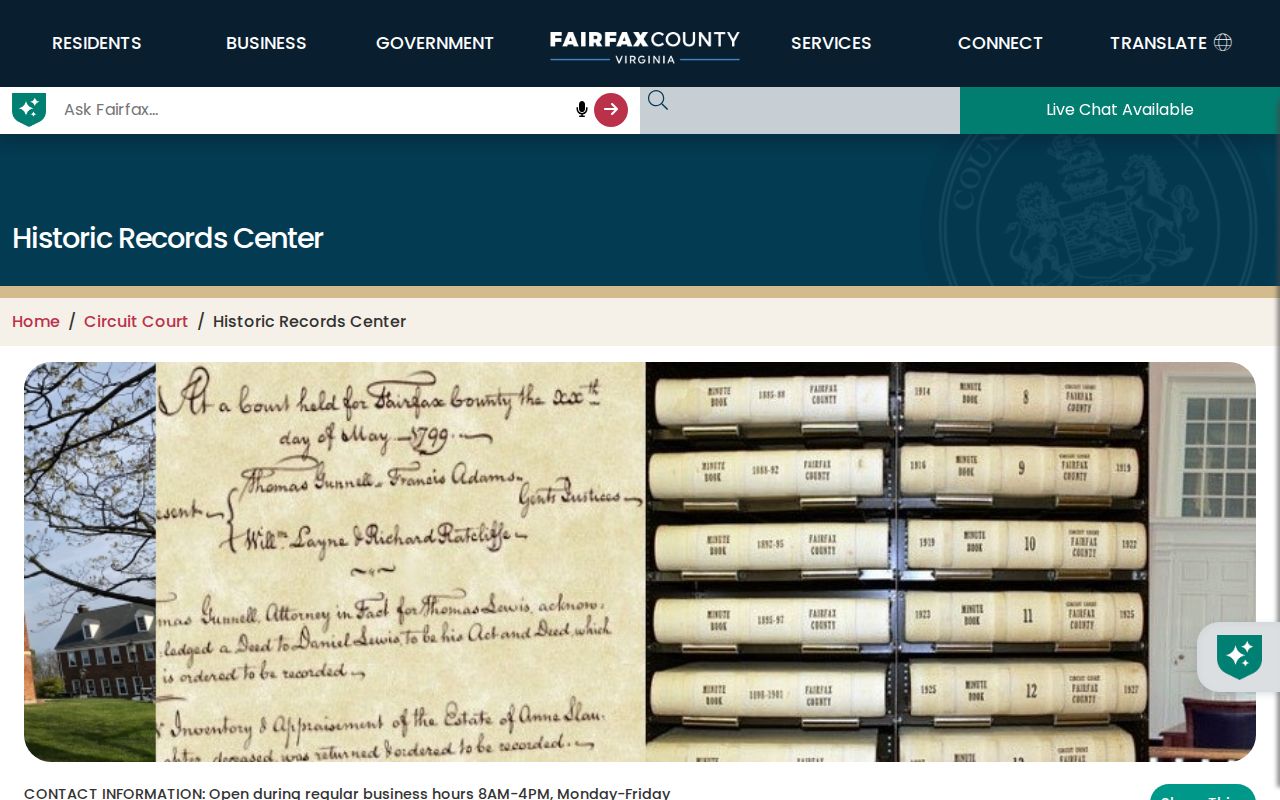
The center is at 4110 Chain Bridge Road, Suite 317, Fairfax, and is open Monday through Friday from 8 to 4 by appointment. Its phone is 703-246-4168. Arrange the visit before relying on a book, box, or index being available at a public terminal.
The HRC holdings page documents the record groups and date ranges behind the address trail.
The holdings support a broader address history, but each result still needs a matching parcel, legal description, map feature, or clearly dated address reference.
Maps for Merrifield Previous Residents
Maps help establish what was on the land and how a parcel changed. HRC’s 1760 owner and occupant map and 1860 biography and tax map are early land-context clues. Fairfax GIS historical imagery begins in 1937, and Digital Map Viewer property-map books form an annual series back to 1960. These sources can show a road, subdivision, parcel pattern, or structure date. They do not identify a prior household by themselves.
Virginia Room property-history bibliographies are the source for this Merrifield past-residents research image.
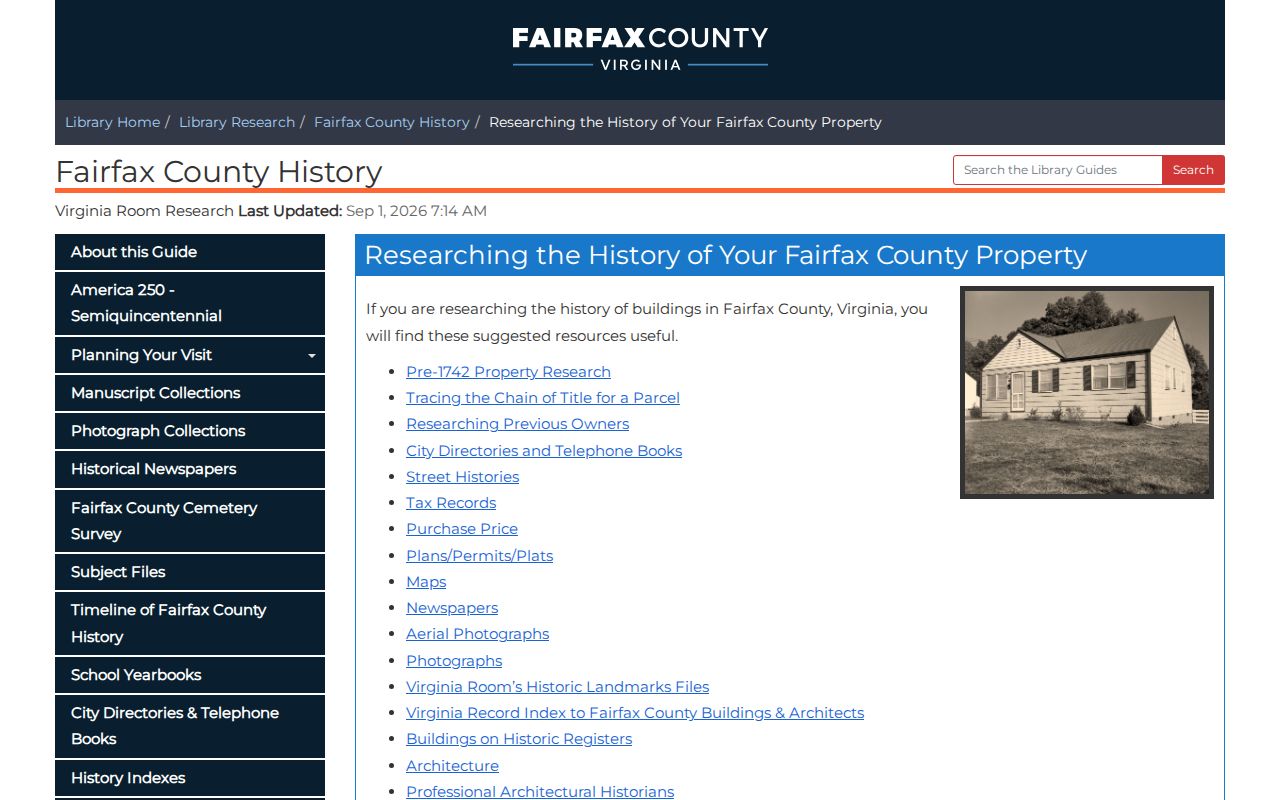
The Virginia Room can also direct researchers to maps, photographs, manuscripts, directories, and newspaper access. Ask for the property-history bibliography and HRC map or tax files rather than assuming a packaged house-history report is available.
Note: Use an aerial to date land use or a building’s visible outline, then pair it with a directory, deed, or census source for a person-related conclusion.
Past Residents in Directories and Census
Recorded owners are only one layer of an address history. The Virginia Room holds historical Northern Virginia directories and telephone books. For Merrifield context, useful runs include Hill’s Falls Church volumes from 1957 through 1975, Hill’s Fairfax from 1963 through 1975, Hill’s Vienna from 1966 through 1974, and Fairfax Community Directory editions from 1980 through 2005–06. Haines Criss-Cross Northern Virginia, which can support a reverse address search, is held by Arlington Public Library’s local-history collection rather than the Virginia Room.
The volumes themselves are described on the Merrifield city directories page. To trace one address, preserve the edition and page, then compare its date with the federal census schedule. Federal schedules through 1950 are public under the 72-year release rule. A directory entry is an edition-date contact, while census evidence is a historical household snapshot.
- Find the target address or street heading in the nearest reverse or community directory edition.
- Check one earlier and one later edition, noting variations in street name, postal city, and house number.
- Search the named entry in the alphabetical section and record the publisher, page, and any notation that actually appears.
- Pair the result with the relevant census year, then return to the deed legal description to make sure the same property is in view.
- Use an obituary, cemetery inventory, or probate record as an endpoint only when its date, relationships, and address evidence corroborate the trail.
Merrifield Previous Residents and Old Addresses
Address continuity is a real problem in the Merrifield corridor. Route 29, Route 50, Lee Highway, and Lee-Jackson Memorial Highway can appear as historical or current road references. The research did not locate a verified Merrifield-specific renumbering event or year. Do not invent one. Instead, use MAR created and expired dates, the deed legal description, historic directory headings, older map tiles, and nearby landowner names to bridge a change.
A rural route, farm name, or large tract may predate the modern street number. When a parcel was subdivided, search the subdivision, lot or block, parcel suffix, plat, and adjoining-owner language rather than forcing an old source into a present address. The same road may also appear under Falls Church, Vienna, Fairfax, Dunn Loring, or another suburban directory heading depending on the edition.
Gaps in Merrifield Previous-Resident Evidence
Fairfax history includes an important documented gap. Original wills, deeds, and loose papers were destroyed during the Civil War, and 26 of 56 deed books covering 1763 through 1819 are missing. A no-result in that span does not mean that a person or parcel had no record. HRC’s surviving books, maps, tax material, and loose papers provide alternate paths, but the gap should stay visible in the research note.
Fairfax historical circuit-record information is the source for this image of the older-record route.
A 2025 state grant to preserve the 1879 Atlas of Fairfax County and land tax books for 1892, 1900, and 1910 offers another future bridge for parcel chronology. Check the custodian for current availability rather than assuming the materials are already searchable online.
Respecting Merrifield Previous Residents
Previous-residents research is strongest when it states the evidence and its limits. A deed records a transfer. A directory supplies a dated address lead. A census schedule records a historical household. A family notice can add an endpoint but may need corroboration. Keep a timeline with the year, person or entity, role, address form, record, citation, and confidence note. That prevents a current owner, an older directory entry, and a later obituary from becoming one unsupported story.
Note: When a record conflicts with a parcel or date, retain the conflict and seek the custodian’s original book, file, map, or directory rather than guessing.