
Follow a Merrifield Street Directory Trail
Fairfax County, rather than a Merrifield municipal office, keeps the key address records. Begin with the written address, not a person’s name. The most dependable chain is address to parcel, parcel to current property report, property report to the recorded instrument, and then to dated directory evidence. That sequence keeps an owner, a tax correspondence address, and a historical occupant from being treated as the same thing. A result tied to a parcel is also easier to recheck when a postal label says Falls Church or Vienna even though county records place the parcel in Merrifield context.
- Use USPS and the county Master Address Repository, known as MAR, to preserve the full road name, postal label, unit when available, and the linked parcel or PIN.
- Open the same address or PIN in iCare and record the owner or entity, situs address, mailing address, sale details, physical description, and assessment neighborhood.
- Use Jade GIS to inspect the parcel outline, road, building, district, zoning, flood, and historical-imagery layers. Keep the PIN with your notes.
- Search Fairfax Circuit Court land records by the owner’s name and confirm the legal description, book or page, and instrument date before following a seller backward.
- For a dated household clue, consult an appropriate reverse directory or community directory and note its edition, page, and address heading.
Virginia voter registration can provide a lawful, dated registration clue through the individual status route. It is not a street-wide occupancy list, and a registration result does not establish current physical presence or ownership.
MAR for Merrifield Street Searches
Fairfax County’s Master Address Repository is the address bridge when a road has more than one spelling, postal city, or historical form. Its Address mode can use address number, street name and type, city, ZIP, parcel ID, subdivision, created and expired dates, and current or historical status. MAR also has parcel and street modes. Those dates matter because the service’s address records begin in 2004, so older continuity still needs maps, deeds, and directories.
The MAR capture below is from the county’s official address-resource page. It is useful for checking the available search paths before entering a street address.
Fairfax County documents MAR search modes and exports here.
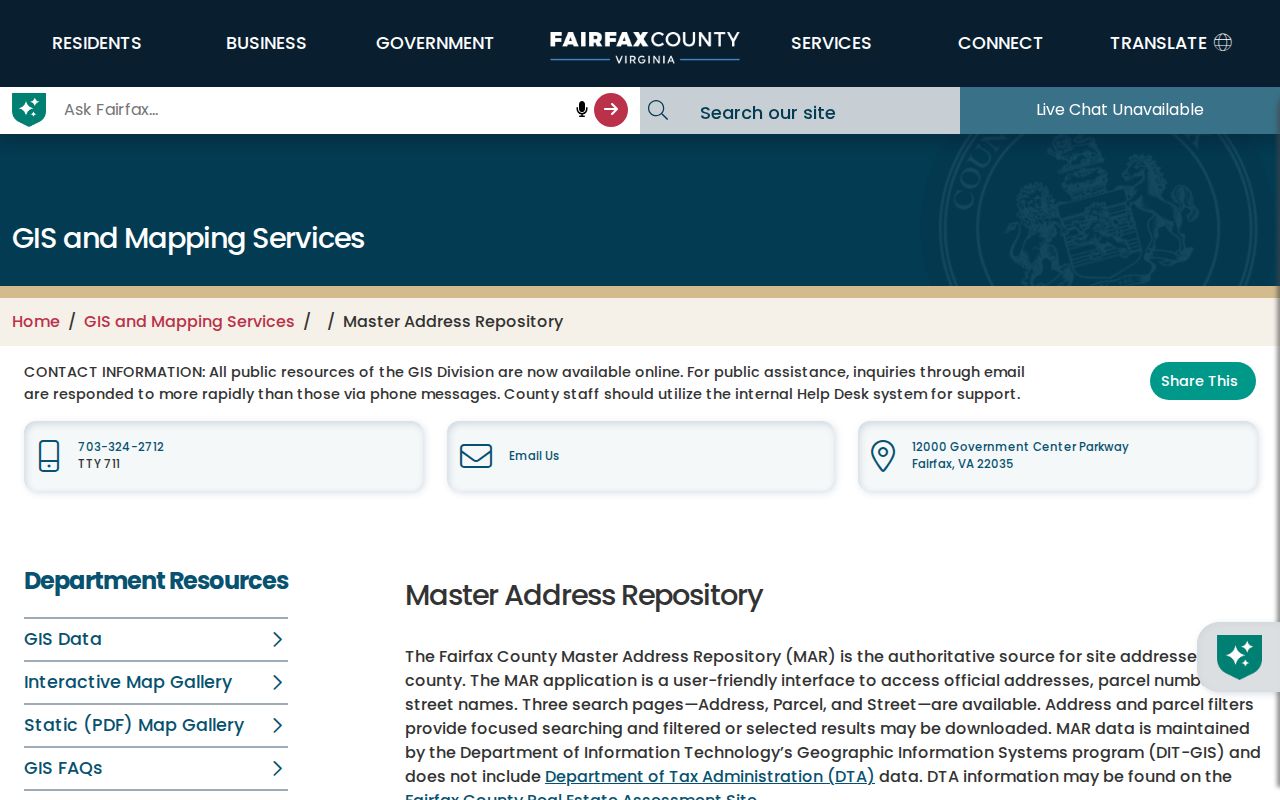
Use the returned parcel association and created or expired date as research notes, not as proof that every unit at a building has an individual public address row.
iCare at a Merrifield Street Address
The Fairfax Department of Tax Administration iCare site is the present-day property starting point. It supports address, map-number, and map-search routes, and the assessment system supports owner-name searching. For an address search, use the house number and street name as they appear in the county record. Preserve a PIN exactly, including leading zeroes and any suffix letters. iCare is updated twice weekly and reports property information authorized by Virginia law, but it remains an informational property source rather than a legal boundary survey.
| iCare mode or field | How it helps an address search |
|---|---|
| Address number | Starts the visible address route; requiredness was not preserved in the official capture. |
| Street name | Use the county road-name form and test a documented variant if needed. |
| Search | Returns parcel candidates for the entered address. |
| Clear or Back | Observed controls for revising an address query. |
| Map Number | Alternative text route for a known PIN or map number. |
| Map Search | Alternative parcel-selection route; live control details were not captured. |
| Owner name | Available through the assessment system; exact field placement was not preserved. |
The property card can show an owner or entity, tax mailing address, situs address, assessed land and building values, sale data, physical characteristics, and assessment neighborhood. A mailing address may belong to an agent, trust, lender, manager, or an owner elsewhere. Keep it separate from the property’s situs address.
The official iCare home page shows the current assessment search entry points.
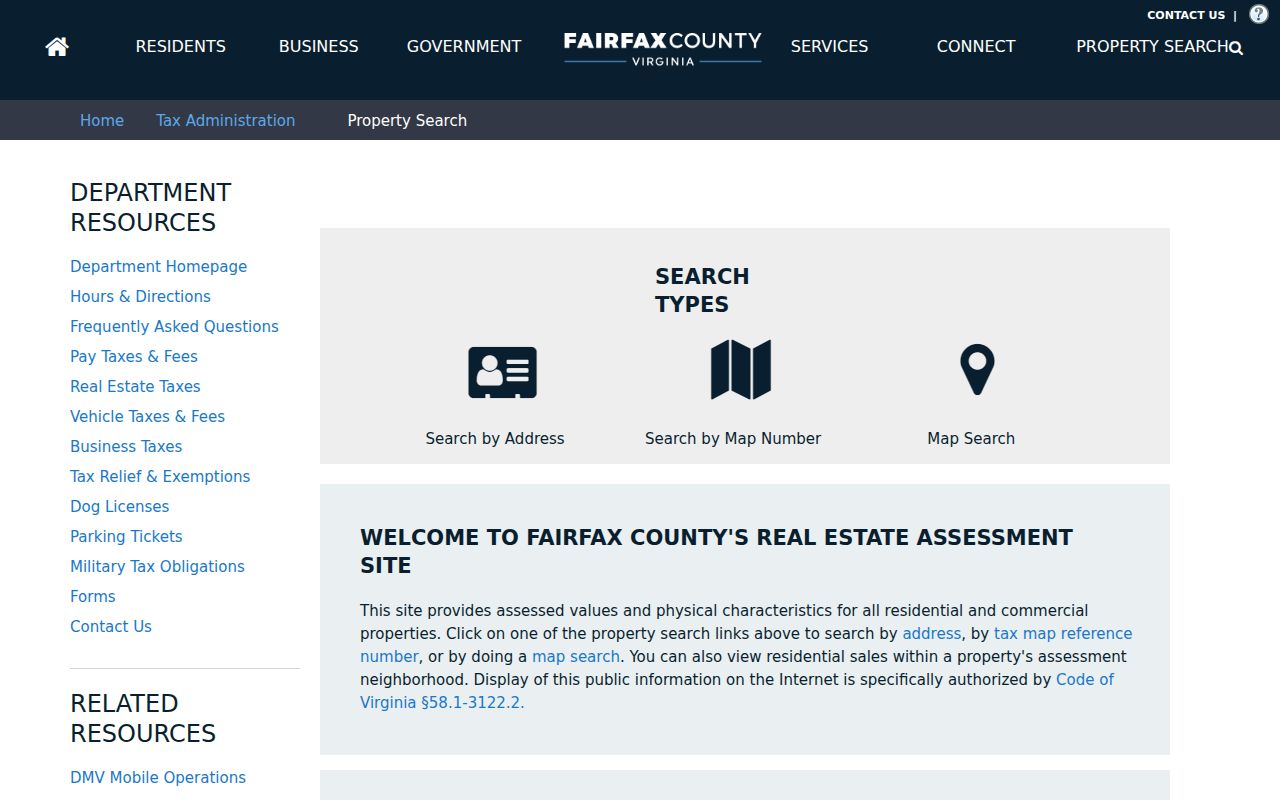
The portal’s modes help locate a parcel, while the field values on the returned report supply the stable identifiers needed for a deed or map check.
Jade GIS on a Merrifield Street
Fairfax GIS Jade and the county map tools turn an address result into a spatial check. Parcel reports, current and historical aerials, map layers, save, share, print, measurement, and export tools are available through the GIS environment. GIS displays the parcel boundary while DTA manages property data; the PARID field joins the two systems. A parcel click can reveal roads, buildings, districts, zoning, flood context, and adjacent shapes, but the displayed line is not a survey.
The county GIS landing page is the source for this Merrifield street-directory image.
Open the Fairfax GIS map and aerial resources.
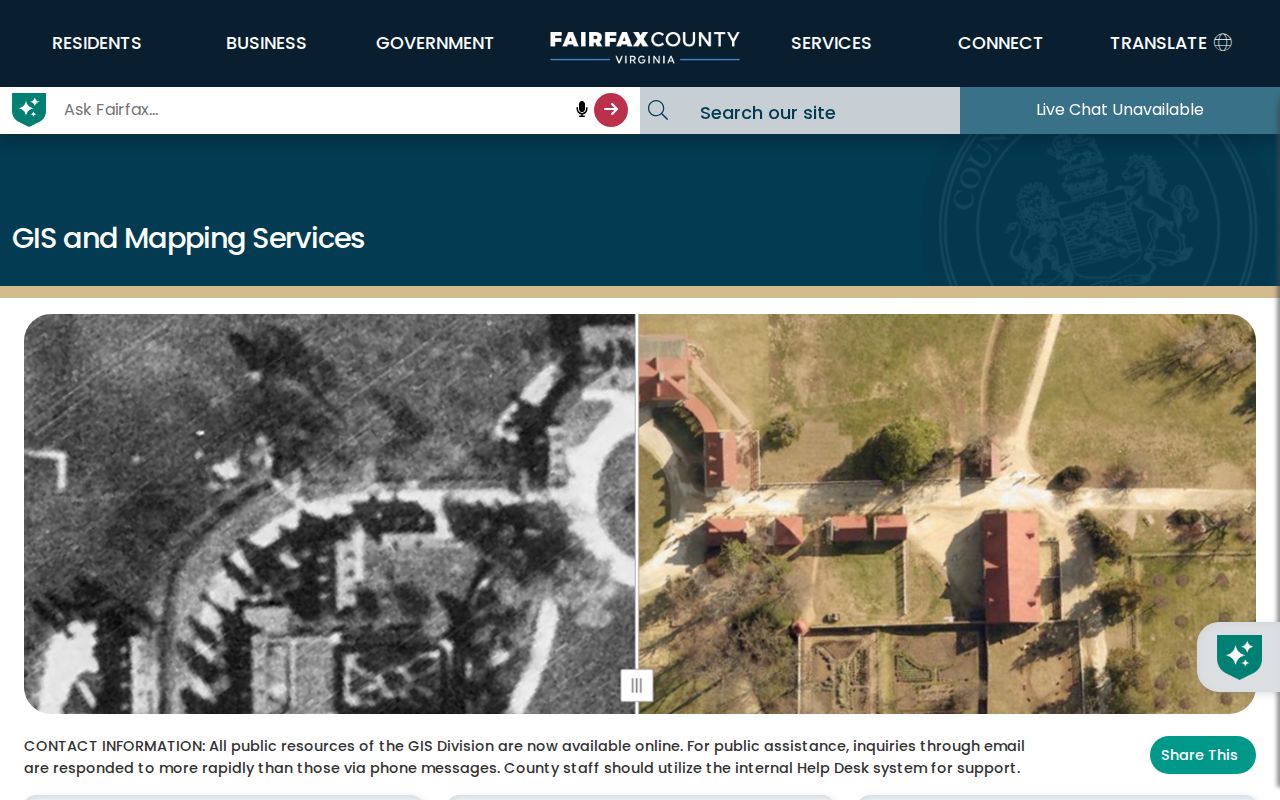
Historical imagery reaches back to 1937 and can date visible structures or land-use change. It cannot identify who lived at an address.
Note: A map is best used to compare parcel context and dates, then checked against the property report and recorded legal description.
Merrifield Street Records by Source
Address-keyed sources have different strengths. A property report identifies the parcel and current assessment data. A map puts it in place. A deed describes a transaction and legal land identity. Directories can add a dated address-to-name lead. The table separates those roles so a reader does not overstate one record type.
| Address-keyed source | Custodian or route | What it can establish | Access channel |
|---|---|---|---|
| Assessment parcel card | Fairfax DTA iCare | Owner or entity, situs and mailing addresses, assessment and sale details | Public web portal and terminals |
| Address and parcel geography | MAR and Jade GIS | PIN, parcel association, street status, dates, layers, and mapped context | Public viewer, map services, and exports |
| Recorded instruments | Fairfax Circuit Court Land Records and HRC | Grantor, grantee, legal description, book or page, plats, liens, and easements | CPAN, public research terminals, and archival appointment |
| Construction chronology | Fairfax Land Development PLUS | Project, applicant or contractor, plan status, inspection, and construction clues | Public workflow documented; live field coverage was not verified |
| Historic directory layer | Virginia Room and Arlington local history | Dated name-to-address or address-to-name leads by edition | Onsite volumes, microform, and repository help |
A permit applicant may be connected to construction without being the person who lived there. Treat permits as dates and corroborating evidence, then use the deed, assessment report, or an appropriate historical directory to determine the record’s role.
Deed Chains Along a Merrifield Street
Fairfax Circuit Court Land Records, rather than a separate county recorder, holds the deed trail. An address normally needs conversion to a PIN or owner first because the deed index is built around grantor, grantee, book, and page searching. Find the current owner as grantee around the iCare acquisition date, confirm the legal description, then search the seller as grantee for the earlier acquisition. Repeat carefully through trusts, estates, corporate name changes, releases, and trustee deeds.
- Parcel
- A tax and mapping unit linked to a PIN or map number. It is more stable than a loose street-name match.
- Situs address
- The physical location of a parcel, distinct from the place tax notices are mailed.
- Plat
- A recorded map that can connect a larger tract to a subdivision, lot, block, or parcel configuration.
- Criss-cross directory
- A reverse directory organized from address to a dated name entry, sometimes with a separate name section.
Land documents run from 1742 to the present, but access changes with the era. Public web access uses CPAN, public terminals are available in the Research Room, and older deed books require the Historic Records Center. The HRC is at 4110 Chain Bridge Road, Suite 317, Fairfax; it is open Monday through Friday from 8 to 4 by appointment for onsite research. Call 703-246-4168 or use the office email route before visiting.
Voter Clues on Merrifield Streets
The Virginia Department of Elections registration route provides individual status tools, while the Fairfax County Office of Elections can answer precinct questions. Virginia’s public voter categories include name, residence address, year of birth, gender, and election districts, subject to protected-address rules. Social Security information, full birth date, and ballot choices are not public. A same-name match should be compared with the parcel, postal label, and district layer, not treated as automatic confirmation.
Full-list access follows a separate state channel and purchaser statement with permitted-use conditions. Current request fees, file format, and delivery options were not located in the reviewed official materials. Do not expect an unrestricted street roster. An inactive, cancelled, or dated registration also cannot establish current occupancy.
Address Changes in Merrifield Street Research
Merrifield is an unincorporated Fairfax County CDP and planning context, not a postal city. A parcel can carry a Falls Church or Vienna mailing label while county data places it in Merrifield context. Preserve both labels. The county’s Bonds and Addressing Center manages emergency, mail, and address data through MAR, while address-change applications use the PLUS workflow. MAR created and expired dates help bridge a modern record to an earlier address form.
Street-name changes have their own documented process. A request needs a street record in PLUS, a petition signed by at least 51 percent of lot owners, and a plat. The research did not verify a Merrifield-specific renumbering event, so an older result should be checked against historic maps, legal descriptions, and road variants such as Lee Highway, Lee-Jackson Memorial Highway, Route 29, or Route 50.
Fairfax County’s address-assignment guidance is the source for this Merrifield street-directory image.
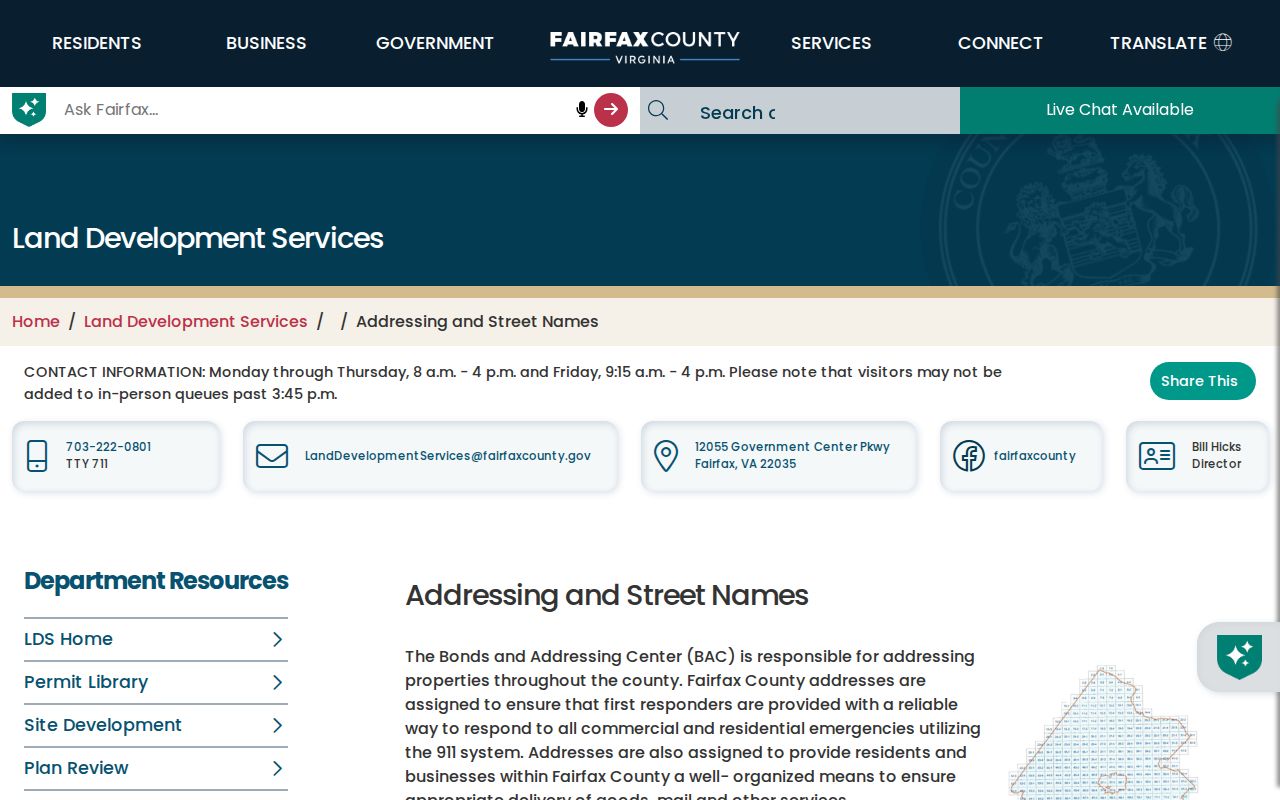
The county address process provides the official route for an address-change request. It does not turn a postal city label into a municipal jurisdiction.
Fairfax County’s street-name-change guidance is the source for the filing requirements shown here.
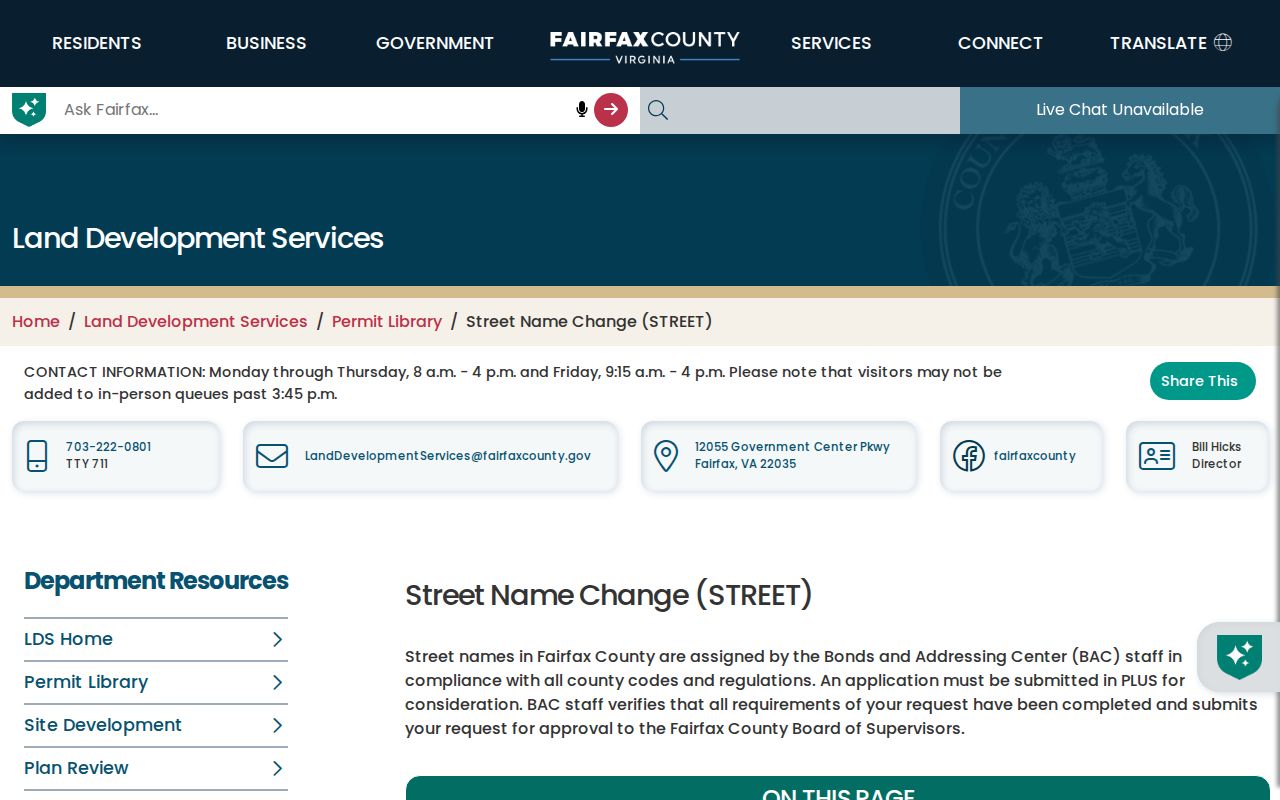
The filing route explains how a formal name change is handled, but it does not establish that any particular Merrifield street was renamed or renumbered.
Criss-Cross Clues for Merrifield Streets
Historic address work often moves from a modern parcel to an older directory entry. The Virginia Room has Northern Virginia directories and telephone books, including Hill’s Alexandria suburban volumes from 1966 through 1973, Hill’s Fairfax volumes from 1963 through 1975, Hill’s Falls Church volumes from 1957 through 1975, and Hill’s Vienna volumes from 1966 through 1974. Fairfax Community Directory editions from 1980 through 2005–06 explicitly include Merrifield. Each volume is dated evidence, not a complete present-day list.
Haines Criss-Cross Northern Virginia is not held by the Virginia Room. Arlington Public Library’s Center for Local History holds early-1970s-to-present Haines volumes that include Fairfax streets. This is a useful fallback when the Virginia Room shelf has no reverse volume. The collection details, publishers, and holdings belong on the Merrifield city directories page; use the edition and page here only to support the address trail.
Limits of a Merrifield Street Directory
A property owner, tax recipient, deed grantee, directory subscriber, voter match, and permit applicant can all be different people or entities. Address records cannot reliably list every person connected with a building. Department of Motor Vehicles addresses, utility accounts, delivery accounts, protected voter addresses, and many personal household details are not public street data. Condominiums and larger buildings add another caution because MAR may not show unit numbers for many apartment addresses.
Note: Keep only the parcel, edition, instrument, and date details needed for the question, then verify an important conclusion with the responsible Fairfax custodian.